Candles, Laurels, Tunnels
|
Dan Albertson [March 2025.]
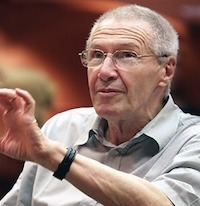
[With gratitude to Akira Maruyama, for the fond memories.] Hungary, with less than 10 million people and its unrelated language, remains outsized and singular in its artistic heft. Early infatuations with Béla Bartók linger, and as one tree tends to sprout boughs in all directions, a veritable silva hungarica has soon rooted itself in the display window of artistic predilections. Common threads there may or may not be. Who believes in geographical determinism, anyway? * * * The candles belong to György Kurtág, who turned 100 last month and who has often featured in the byways of La Folia. As a composer of paradoxes and surprises, one could dwell on his affinity for the voice or the cimbalom or the piano, for the combination of playfulness and rigor, for the might of the microcosm. What may be overlooked, however, is his aptitude with larger forces, whether in the haunted and at times pained Grabstein für Stephan or the elusive yet transfixing …concertante…, a work explored in greater detail by a younger version of the present writer here but now viewed with much greater admiration. A master miniaturist, sure, but stature is not the point, since by duration alone many of his smallest-scale works are massive. (There are, by the way, at least three living composers older than Kurtág, one each born in 1921, 1923 and 1925.) * * * Laurels for László Krasznahorkai, an old favorite of Walt Mundkowsky, in the form of the Nobel Prize. Bleakness in humor and observation lies at the core of many of Krasznohorkai’s early novels, especially The Melancholy of Resistance, down to its final painstaking pages on decay. Who else could write a book with a single sentence that succeeds as both an experiment and an engaging work of art? Verbal pyrotechnics aside, his Herscht 07769 is a marvel of wit and a capsule of derangement. Plenty of J.S.B. lies in there, too, a sentence that could equally apply to Kurtág. * * * Béla Tarr died in January. As filmmakers go, he occupied rarefied air, not merely for the magnitude of his achievements – not a dull film in thirty years – and not for the fact that he retired in his 50s, either: how could one follow The Turin Horse? No, his rank is a result of his singularity of vision, one that inspires many imitators and no equals. From literary sources – yes, from and with Krasznahorkai – he made gripping cinema without the burden of narrative or plot, a sentence that could equally apply to Krasznahorkai. The involvement of his wife Ágnes Hranitzky must not be overlooked, and one can suppose that with time her varied roles will become more broadly known. Could the same apply to Márta Kurtág? * * * Right, who believes in geographical determinism, anyway? [Picture of György Kurtág from https://www.umpemb.com/en-US/Composers/K/Kurtag-Gyorgy.aspx, https://sitecoreaudioprod.umusicpub.com/sitecore_media/9A86662C-4FAD-49FC-9FCB-E0E1C9C35787.jpg] [More Dan Albertson]
[More
Kurtág]
[Previous Article:
Used Bin Troll Tweets CCCC.]
[Next Article:
Piano Factory 35.]
|